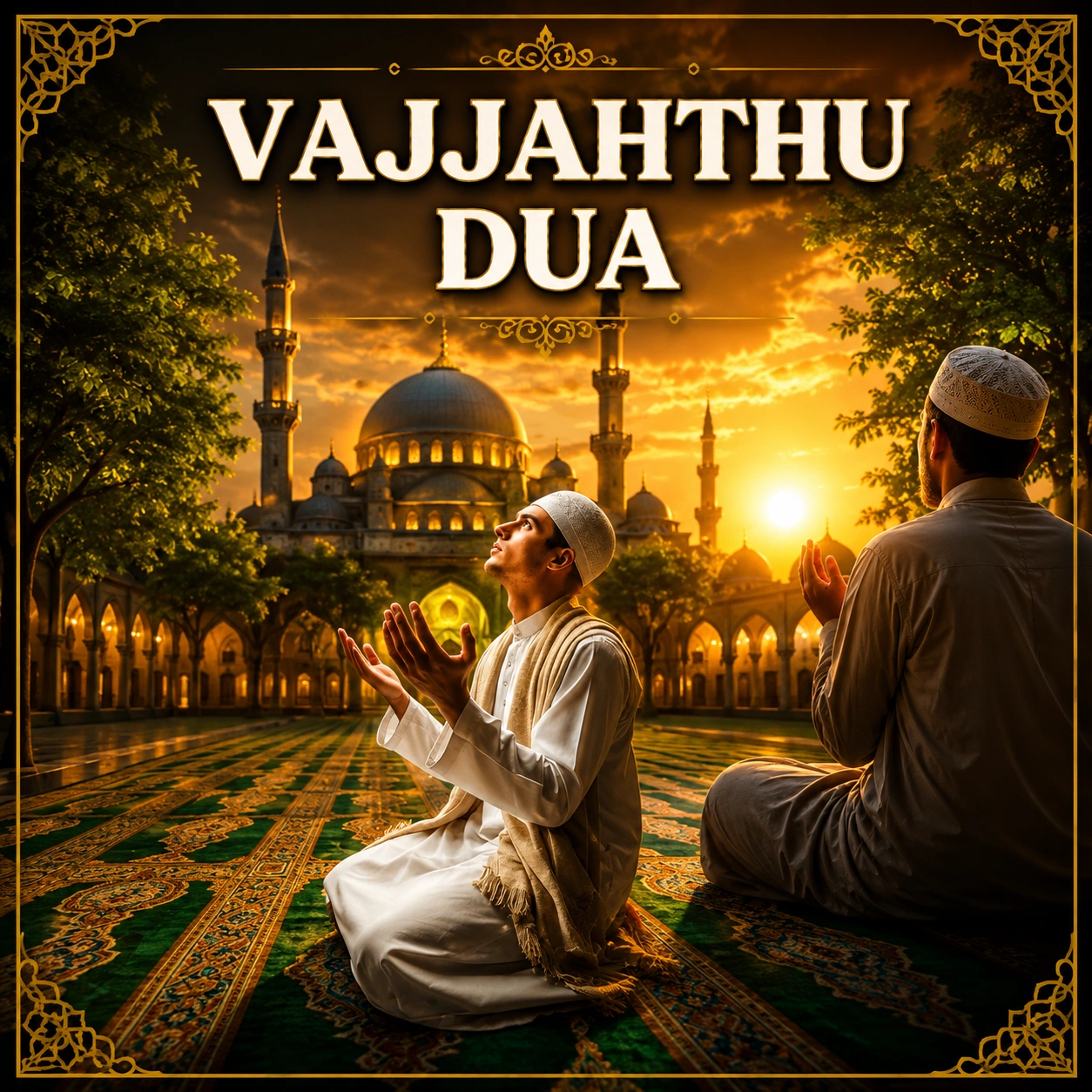
Vajjahthu Dua begins every Salah with a moment of complete stillness a silent, powerful declaration between a believer and Allah.
Also known as Dua Istiftah (Opening Supplication of Prayer), the Vajjahthu Dua is recited silently right after the opening Takbeer (Allahu Akbar) and before Surah Al-Fatiha. It is one of the most complete and moving supplications a Muslim utters in daily worship.
The word “wajjahtu” means “I have turned.” So when a believer says Inni wajjahtu wajhiya they are declaring to Allah: “I have turned my entire face, heart, and soul toward You.” Not just the body facing the Qiblah, but the whole being directed entirely toward the Creator.
Authentically narrated in Sahih Muslim (Hadith No. 771), reported by Sayyidna Ali ibn Abi Talib (RA), the Prophet Muhammad (ﷺ) used to recite it at the beginning of every prayer. It is a pure act of Sunnah and a beautiful habit every Muslim can hold close.
Vajjahthu Dua in Arabic
Below is the correct and complete Vajjahthu Dua in Arabic:
إِنِّي وَجَّهْتُ وَجْهِيَ لِلَّذِي فَطَرَ السَّمَاوَاتِ وَالْأَرْضَ حَنِيفًا وَمَا أَنَا مِنَ الْمُشْرِكِينَ
إِنَّ صَلَاتِي وَنُسُكِي وَمَحْيَايَ وَمَمَاتِي لِلَّهِ رَبِّ الْعَالَمِينَ
لَا شَرِيكَ لَهُ وَبِذَلِكَ أُمِرْتُ وَأَنَا مِنَ الْمُسْلِمِينَ
The Vajjahthu Dua in Arabic is preserved exactly as narrated from the Prophet (ﷺ). Every word carries deep theological weight. Recite it slowly and with awareness it is not just an opening phrase, it is a covenant with Allah.
Vajjahthu Dua Transliteration
For those learning the dua or needing pronunciation help, here is the easy Roman transliteration of the Vajjahthu Dua in English phonetic form:
Inni wajjahtu wajhiya lil-ladhi fatara as-samawati wal-arda, hanifan wa ma ana minal mushrikeen.
Inna salati wa nusuki wa mahyaya wa mamati lillahi rabbil ‘alameen.
La shareeka lahu wa bidhaalika umirtu wa ana minal muslimeen.
Take your time with “wajhiya,” “fataras-samawati,” and “bidhaalika umirtu” these are the slightly harder phrases. With a few days of practice, the full dua flows naturally.
Vajjahthu Dua Meaning in English
Here is the word-by-word breakdown of the Vajjahthu Dua with meaning in English:
| Arabic Phrase | Meaning in English |
|---|---|
| Inni wajjahtu wajhiya | Truly, I have turned my face |
| Lil-ladhi fatara as-samawati wal-arda | Toward the One who created the heavens and the earth |
| Hanifan | Being purely monotheistic (upright in faith) |
| Wa ma ana minal mushrikeen | And I am not among those who associate partners with Allah |
| Inna salati wa nusuki | Indeed, my prayer and my sacrifice |
| Wa mahyaya wa mamati | And my living and my dying |
| Lillahi rabbil ‘alameen | Are all for Allah, Lord of all the worlds |
| La shareeka lahu | He has no partner |
| Wa bidhaalika umirtu | And this is what I have been commanded |
| Wa ana minal muslimeen | And I am among those who submit (Muslims) |
Disclaimer: The information provided in this article about the Vajjahthu Dua is written for general Islamic educational purposes only. All Arabic text, translations, and references have been taken from authentic Islamic sources, including Sahih Muslim and established scholarly works.
Simple meaning of the Vajjahthu Dua in English:
“I have turned my face sincerely toward the One who created the heavens and the earth, and I am not among those who associate partners with Allah. Verily, my prayer, my sacrifice, my living, and my dying are all for Allah, the Lord of all the worlds. He has no partner, this is what I have been commanded, and I am among the Muslims.”
Vajjahthu Dua Meaning in Hindi (हिंदी अर्थ)
हिंदी में Vajjahthu Dua का अर्थ:
“बेशक मैंने अपना चेहरा उस ज़ात की तरफ कर लिया जिसने आसमानों और ज़मीन को पैदा किया, एक ऐसे शख्स की तरह जो सीधे रास्ते पर हो, और मैं मुशरिकों में से नहीं हूँ।”
“बेशक मेरी नमाज़, मेरी क़ुर्बानी, मेरी ज़िन्दगी और मेरी मौत सब कुछ अल्लाह के लिए है जो तमाम जहानों का रब है।”
“उसका कोई शरीक नहीं। और मुझे यही हुक्म दिया गया है और मैं मुसलमानों में से हूँ।”
Explanation of the Vajjahthu Dua
What This Dua Really Means
The Vajjahthu Dua is not a casual opening phrase. It is a declaration of Tawheed the complete oneness of Allah.
When a Muslim says “Inni wajjahtu wajhiya,” the word “wajhiya” (my face) carries the entire self heart, mind, will, and soul. The believer is saying: I am not just physically facing Makkah. My entire existence is now directed toward Allah alone.
The phrase “hanifan” meaning a pure monotheist who has turned away from falsehood is deeply significant. It reflects the legacy of complete and unwavering faith. This word signals that the believer is free from all doubts, distractions, and false attachments.
Then comes the most powerful line: “Inna salati wa nusuki wa mahyaya wa mamati lillahi rabbil ‘alameen” My prayer, my sacrifice, my living, and my dying are all for Allah. This is not just about the Salah happening right now. It is a dedication of the entire life to Allah.
Its Connection to the Quran
Many people search for the Vajjahthu Dua in Quran and there is a meaningful connection worth knowing.
The Vajjahthu Dua is not a Quranic verse recited in Salah. However, it is closely inspired by Surah Al-An’am, verse 79, where Allah describes Sayyidna Ibrahim (AS):
إِنِّى وَجَّهْتُ وَجْهِىَ لِلَّذِى فَطَرَ ٱلسَّمَٰوَٰتِ وَٱلْأَرْضَ حَنِيفًا “I have turned my face toward the One who created the heavens and the earth, as a true monotheist.” Surah Al-An’am (6:79)
The Prophet (ﷺ) combined the spirit of this Quranic declaration into the opening supplication of Salah. So when you ask Vajjahthu Dua in which Surah the closest Quranic parallel is Surah Al-An’am (6:79). But the full dua as recited in prayer comes from the authentic Hadith narrated in Sahih Muslim.
By reciting this dua, every Muslim walks in the footsteps of Sayyidna Ibrahim (AS) and renews the same declaration of pure faith before Allah.
When to Read the Vajjahthu Dua — In Prayer
The Vajjahthu Dua in prayer is recited at a very specific and important moment:
- After the opening Takbeer (Allahu Akbar) at the very start of Salah
- Before reciting Surah Al-Fatiha
- Recited silently — not aloud in all prayers
- In the first rak’ah only, according to the majority of scholars
- Particularly emphasized in Tahajjud, Nawafil, and night prayers
There is a difference of opinion among scholars about which Dua Istiftah is best for the five obligatory prayers. Many Hanafi scholars prefer Subhanakallahumma for Fard prayers, while the Vajjahthu Dua is widely recommended for Nafl and night prayers. The Shafi’i and Hanbali schools consider it Sunnah in all prayers.
In all cases, it is a Sunnah act not obligatory. Your Salah is valid without it, but reciting it with understanding adds depth, focus, and sincerity to every prayer.
Guidance by School of Thought:
| School (Madhab) | Position on Vajjahthu Dua |
|---|---|
| Hanafi | Prefers Subhanakallahumma for Fard; Vajjahthu Dua used in Nafl/night prayers |
| Shafi’i | Strongly recommends it as the opening supplication |
| Hanbali | Considers it Sunnah in all prayers |
| Maliki | Generally no opening dua; prayer starts with Fatiha |
When in doubt, consult a trusted local scholar or follow the practice of your mosque.
Benefits of the Vajjahthu Dua
The following spiritual benefits of the Vajjahthu Dua are derived from its meaning and from the broader teachings of the Prophet (ﷺ):
1. Reaffirmation of Tawheed (Oneness of Allah)
Every time a Muslim recites this dua, they consciously declare that Allah alone deserves worship and that no partner exists beside Him. This strengthens Iman (faith) with every prayer, five times a day.
2. Following the Sunnah of the Prophet (ﷺ)
This dua is directly narrated in Sahih Muslim. Reciting it is a clear act of Sunnah and every Sunnah act brings closeness to the Prophet (ﷺ) and reward from Allah.
3. Achieving Khushu’ (Focus and Presence) in Salah
The words “my living and my dying are for Allah” shift the heart from worldly thoughts to complete presence in prayer. The Vajjahthu Dua with meaning understood in the heart creates deep concentration in Salah.
4. Spiritual Clarity of Intention
By openly declaring freedom from shirk and total devotion to Allah, the believer enters Salah in a state of pure and sincere intention. There is no ambiguity this prayer is only for Allah.
5. Connection with Sayyidna Ibrahim (AS)
Reciting the same words that echo the declaration of Prophet Ibrahim (AS) creates a spiritual bond across time. A believer stands in the same tradition of pure faith that Ibrahim (AS) embodied.
Vajjahthu Dua — Quick Reference
| Detail | Information |
|---|---|
| Full Name | Inni Vajjahthu / Wajjahtu Wajhiya |
| Also Known As | Dua Istiftah (Opening Supplication) |
| When Recited | After the opening Takbeer, before Surah Al-Fatiha |
| Hadith Reference | Sahih Muslim (No. 771), narrated by Ali ibn Abi Talib (RA) |
| Quranic Connection | Surah Al-An’am (6:79) |
| Recitation Type | Silent |
| Obligation Level | Sunnah (Recommended, not obligatory) |
| Who Recites It | Men and women both |
Read Also: Asar Ki Namaz Ki Rakat
Conclusion
Vajjahthu Dua is among the most complete declarations a Muslim makes in daily worship. In a few short lines, it covers the entire scope of a believer’s life prayer, sacrifice, living, and dying all dedicated entirely to Allah alone.
When recited with awareness of its meaning, the opening of every Salah transforms into something far deeper. It becomes not just a ritual beginning but a moment of profound renewal a fresh covenant with Allah made five times a day.
The Vajjahthu Dua in Arabic preserves the exact words of the Prophet (ﷺ) as narrated in Sahih Muslim. Understanding the Vajjahthu Dua with meaning in the heart brings khushu’ that precious focus and presence into every prayer.
May Allah accept our prayers, grant us khushu’ in Salah, and allow us to follow the Sunnah of the Prophet Muhammad (ﷺ) with sincerity and love.
Ameen.
? FAQs
Q1. What is the Vajjahthu Dua?
The Vajjahthu Dua is the Opening Supplication of Salah, recited silently after the first Takbeer and before Surah Al-Fatiha. It begins with the words “Inni wajjahtu wajhiya” meaning “I have turned my face.”
Q2. Is the Vajjahthu Dua in the Quran?
The Vajjahthu Dua is not a Quranic verse. It is inspired by Surah Al-An’am (6:79) but the full dua comes from authentic Hadith narrated in Sahih Muslim (No. 771).
Q3. What is the Vajjahthu Dua meaning in English?
It means: “I have turned my face toward the Creator of the heavens and earth. My prayer, sacrifice, life, and death are all for Allah alone, and I am among the Muslims.”
Q4. Is the Vajjahthu Dua compulsory in Salah?
No. It is Sunnah highly recommended but not obligatory. Salah remains valid without it.
Q5. When is the Vajjahthu Dua recited in prayer?
It is recited silently right after the opening Takbeer, before Surah Al-Fatiha, in the first rak’ah only.
 Read More Duas Every Day At Islamic Dua Hub