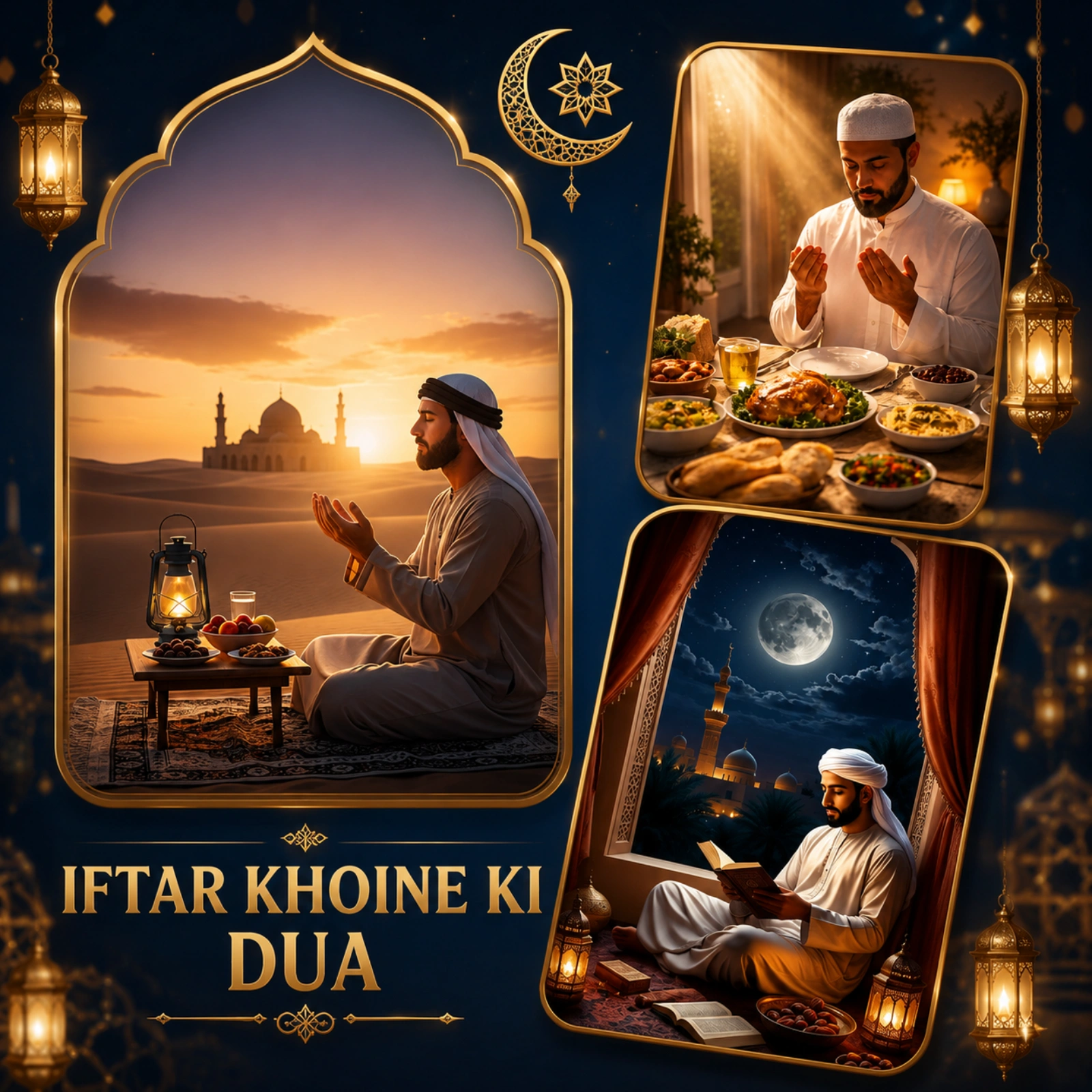
Ramadan is the most blessed month in Islam. Muslims around the world fast from Fajr to Maghrib and wait for the moment of Iftar with deep faith and gratitude. Breaking the fast is not just about eating and drinking it is a spiritual act that begins with the remembrance of Allah.
Iftar Kholne Ki Dua is the supplication that every Muslim recites at the time of breaking their fast. This dua is a moment of deep connection with Allah ﷻ. It is a time when the heart is soft, the soul is hungry, and Allah’s mercy is closest.
The Prophet Muhammad ﷺ taught his companions how to break their fast with specific words of remembrance. This dua reflects gratitude, sincerity, and hope in Allah’s acceptance.
Iftar Kholne Ki Dua in Arabic
The most authentic and widely accepted Iftar Kholne Ki Dua in Arabic is:
اللَّهُمَّ لَكَ صُمْتُ وَعَلَى رِزْقِكَ أَفْطَرْتُ
This dua is recorded in Sunan Abu Dawood (Hadith No. 2358) and is considered authentic by many scholars.
Another well-known version reported in various narrations is:
ذَهَبَ الظَّمَأُ وَابْتَلَّتِ الْعُرُوقُ وَثَبَتَ الْأَجْرُ إِنْ شَاءَ اللَّهُ
This second narration is found in Sunan Abu Dawood (Hadith No. 2357) and is authenticated by Sheikh Al-Albani.
Iftar Kholne Ki Dua – Roman English Transliteration
For those who are not familiar with Arabic script, here is the Iftar Kholne Ki Dua Roman English transliteration:
First Dua:
Allahumma laka sumtu wa ‘ala rizqika aftartu
Second Dua:
Dhahaba al-zama’u wabtallatil ‘urooqu wa thabata al-ajru insha’Allah
Both transliterations are written in simple Roman English so that anyone can read them easily.
Iftar Kholne Ki Dua in English – Meaning
Iftar Kholne Ki Dua in English meaning:
First Dua:
“O Allah, for You I have fasted, and upon Your provision I have broken my fast.”
Second Dua:
“The thirst has gone, the veins are moistened, and the reward is confirmed, if Allah wills.”
These words beautifully express the complete submission of a fasting Muslim to Allah ﷻ. Every word carries deep meaning and sincerity.
Iftar Kholne Ki Dua in Hindi
Iftar Kholne Ki Dua in Hindi meaning (अर्थ):
पहली दुआ:
“ऐ अल्लाह! मैंने तेरे लिए रोज़ा रखा और तेरे रिज़्क़ से इफ़्तार किया।”
दूसरी दुआ:
“प्यास बुझ गई, नसें तर हो गईं और सवाब पक्का हो गया, इन्शाअल्लाह।”
Iftar Kholne Ki Dua in Urdu
Iftar Kholne Ki Dua Urdu ترجمہ:
پہلی دعا:
“اے اللہ! میں نے تیرے لیے روزہ رکھا اور تیرے رزق سے افطار کیا۔”
دوسری دعا:
“پیاس بجھ گئی، رگیں تر ہو گئیں، اور ثواب ثابت ہو گیا، ان شاء اللہ۔”
Explanation – Why This Dua Is Read at Iftar
The act of breaking the fast is a sacred moment in Islamic worship. The Iftar Kholne Ki Dua is not just a formality it carries the spirit of the entire fast.
When a Muslim says “Allahumma laka sumtu” “O Allah, for You I fasted” they are affirming that their fast was not for show, not for health alone, but purely for the pleasure of Allah ﷻ.
When they say “wa ‘ala rizqika aftartu” “and upon Your provision I break my fast” they acknowledge that every bite of food, every sip of water, is a gift from Allah. Nothing belongs to us. Everything comes from Him.
The second dua, “Dhahaba al-zama’u…”, is a dua of relief and gratitude. The thirst is gone. The body is refreshed. And the believer hopes that the reward of the fast has been sealed by Allah ﷻ.
Together, both duas represent the complete attitude of a fasting Muslim surrender, gratitude, and hope.
Disclaimer: The information provided in this article about Iftar Kholne Ki Dua is intended for general Islamic educational purposes only. Every effort has been made to ensure that the Arabic text, transliterations, translations, and hadith references presented here are accurate and authentic. The duas included in this article are sourced from well-known and reliable hadith collections, including Sunan Abu Dawood and Sunan Ibn Majah.
When to Read Iftar Kholne Ki Dua
The correct time to recite Iftar Kholne Ki Dua is:
- At the time of breaking the fast when the Maghrib Adhan begins or when the sun has fully set.
- The dua should be read before or while taking the first bite or sip.
- It is Sunnah to break the fast with dates (Khajoor) first. If dates are not available, water can be used.
- The Prophet ﷺ used to break his fast before offering Maghrib prayer.
It is also narrated that the dua of a fasting person at the time of Iftar is among the duas that are not rejected by Allah. This is a golden moment of acceptance, and every Muslim should make the most of it by making sincere dua and dhikr at Iftar time.
Benefits of Reciting Iftar Kholne Ki Dua
The spiritual benefits of reciting this dua regularly are deeply rooted in Islamic teachings:
1. Fulfillment of Sunnah Reciting the Iftar Kholne Ki Dua follows the practice of Prophet Muhammad ﷺ. Every act of Sunnah carries great reward in Islam.
2. Acceptance of Fast The dua reinforces the intention that the fast was kept for Allah alone. This sincerity is the key to the acceptance of worship.
3. Gratitude to Allah The words of Iftar dua contain deep gratitude. Expressing shukr (thankfulness) to Allah at the moment of breaking the fast strengthens a Muslim’s connection with their Creator.
4. Dua Is Accepted at Iftar The Prophet ﷺ said: “There are three whose supplications are not rejected: a fasting person when breaking fast, a just ruler, and the supplication of an oppressed person.” (Ibn Majah, Hadith No. 1752)
This hadith shows that Iftar is one of the most powerful times for dua. After reciting the Iftar dua, a Muslim should also raise their hands and ask Allah for whatever they need in this world and the Hereafter.
5. Reminder of Dependence on Allah The dua reminds the believer that all provision, all sustenance, and all blessings come from Allah alone. This humility is the foundation of a strong Islamic character.
Read Also: Istakharay Ki Dua
Conclusion
The moment of Iftar is one of the most special moments in a Muslim’s day during Ramadan. After hours of fasting with patience and devotion, the believer turns to Allah ﷻ with words of gratitude and hope.
Iftar Kholne Ki Dua whether recited in Arabic, understood in Hindi, or read in Roman English is a powerful expression of a Muslim’s complete reliance on Allah. It is a reminder that we fast for Allah, we eat from what Allah provides, and we hope for a reward that only Allah can give.
Every Muslim, whether young or old, should make it a habit to recite this dua at the time of Iftar. Teach it to children in simple words. Share it with family members. And make the most of this blessed moment by also raising your hands in personal dua because at the time of Iftar, the doors of acceptance are wide open.
May Allah ﷻ accept our fasts, our prayers, and our duas. Ameen.
? FAQs
Q1. What is the Iftar Kholne Ki Dua in Arabic?
The most commonly read dua is: اللَّهُمَّ لَكَ صُمْتُ وَعَلَى رِزْقِكَ أَفْطَرْتُ. Another narration is: ذَهَبَ الظَّمَأُ وَابْتَلَّتِ الْعُرُوقُ وَثَبَتَ الْأَجْرُ إِنْ شَاءَ اللَّهُ.
Q2. Is there a specific dua for Iftar in the Quran?
No specific Iftar dua is mentioned in the Quran. However, the duas for Iftar are from authentic Hadith sources Sunan Abu Dawood and other reliable collections.
Q3. Can I read both duas at Iftar?
Yes. Many scholars recommend reading both duas. The first dua (Allahumma laka sumtu…) focuses on intention and gratitude. The second dua (Dhahaba al-zama’u…) is a dua of relief and hope in reward.
Q4. What is the best thing to break the fast with?
The Prophet ﷺ used to break his fast with fresh dates, or dry dates, or water. (Sunan Abu Dawood, Hadith No. 2356)
Q5. Is the dua of a fasting person accepted?
Yes. A Hadith in Ibn Majah confirms that the dua of a fasting person at the time of breaking fast is among those that are not rejected. It is highly recommended to make personal supplications at Iftar time.
Q6. What is the Iftar Kholne Ki Dua Roman English?
The Roman English transliteration is: Allahumma laka sumtu wa ‘ala rizqika aftartu. The second is: Dhahaba al-zama’u wabtallatil ‘urooqu wa thabata al-ajru insha’Allah.
Q7. Can a person break their fast silently without a dua?
The fast is still valid. However, reciting the Iftar dua is a Sunnah and a recommended act. A Muslim should not miss this blessed opportunity.
🤲 Read More Duas Every Day At Islamic Dua Hub