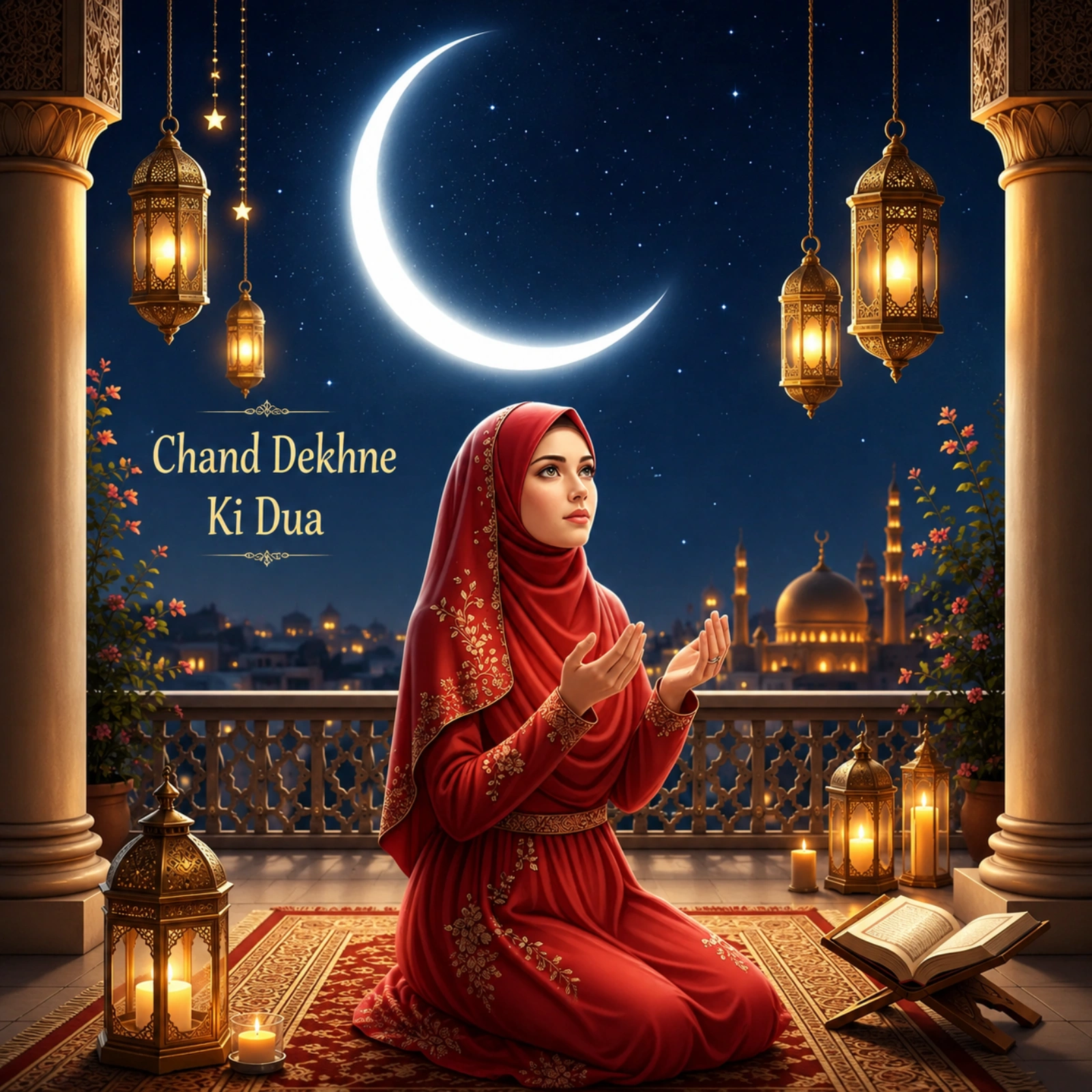
Chand Dekhne Ki Dua is the supplication a Muslim recites upon sighting the new crescent moon at the start of an Islamic month. Since the Hijri calendar depends on the lunar cycle, the appearance of the new moon carries a special place in the daily life of a believer. Every new month, whether it is an ordinary month or a blessed one like Ramzan, begins with this small but meaningful act of remembering Allah.
The Prophet Muhammad (peace be upon him) taught his companions specific words to say the moment they saw the hilal, the thin crescent that marks the beginning of a new month. Reciting Chand Dekhne Ki Dua connects a person’s heart with gratitude, humility, and hope for the coming days. This is especially true when the moon of Ramzan appears, or when the moon of Eid Ul Fitr is sighted after a month of fasting.
Word-by-Word Breakdown
| Arabic Word | Transliteration | Meaning |
|---|---|---|
| اللَّهُمَّ | Allahumma | O Allah |
| أَهِلَّهُ | Ahillahu | Bring it (the moon) forth |
| عَلَيْنَا | Alaina | Upon us |
| بِالْأَمْنِ | Bil-amni | With security/peace |
| وَالْإِيمَانِ | Wal-iman | And with faith |
| وَالسَّلَامَةِ | Was-salamati | And with safety |
| وَالْإِسْلَامِ | Wal-Islam | And with Islam |
| رَبِّي | Rabbi | My Lord |
| وَرَبُّكَ اللَّهُ | Wa Rabbuka Allah | And your Lord is Allah |
Chand Dekhne Ki Dua In Arabic
اللَّهُ أَكْبَرُ، اللَّهُمَّ أَهِلَّهُ عَلَيْنَا بِالْيُمْنِ وَالْإِيمَانِ، وَالسَّلَامَةِ وَالْإِسْلَامِ، رَبِّي وَرَبُّكَ اللَّهُ
This is the exact wording preserved in the collections of hadith and recited by Muslims across the world whenever the new moon becomes visible.
Chand Dekhne Ki Dua Transliteration (Roman)
Allahu Akbar, Allahumma ahillahu ‘alaina bil-yumni wal-iman, was-salamati wal-Islam, Rabbi wa Rabbuka Allah.
Saying it slowly, with hands raised toward the sky and facing the direction of the moon, is the manner described by the companions who narrated this practice from the Prophet ﷺ.
Chand Dekhne Ki Dua In Hindi
अल्लाहु अकबर, अल्लाहुम्मा अहिल्लहु अलैना बिल यु्म्नि वल ईमान, वस्सलामति वल इस्लाम, रब्बी व रब्बुकल्लाह।
अर्थ: अल्लाह सबसे बड़ा है। ऐ अल्लाह! इस चाँद को हमारे ऊपर बरकत और ईमान, सलामती और इस्लाम के साथ निकाल। मेरा रब और तेरा रब अल्लाह ही है।
Chand Dekhne Ki Dua In Hindi padhte waqt yeh dhyan rakhna zaroori hai ke alfaz sahi tarah se ada kiye jayein, kyunki yeh dua seedhe hadees se li gayi hai.
Chand Dekhne Ki Dua In Urdu
اللہ سب سے بڑا ہے۔ اے اللہ! اس چاند کو ہم پر برکت اور ایمان، سلامتی اور اسلام کے ساتھ طلوع فرما۔ میرا رب اور تیرا رب اللہ ہی ہے۔
Urdu boलने वाले musalman aksar Chand Dekhne Ki Dua In Urdu ko yaad karke apne bacchon ko bhi yehi alfaz sikhate hain, taake naya chand dekhte hi zaban par yeh dua aa jaye.
Chand Dekhne Ki Dua In English
“Allah is the Greatest. O Allah, bring this moon over us with blessing and faith, with safety and Islam. My Lord and your Lord is Allah.”
Chand Dekhne Ki Dua In English mein padhne wale log bhi isi hadees wali dua ka tarjuma istemal karte hain, kyunki koi alag dua sabit nahi hai jo sirf English bolne walon ke liye ho.
Disclaimer: This article is for educational and informational purposes. For matters of fiqh or specific religious rulings, please consult a qualified Islamic scholar. If any error is found in the Arabic text or translation, kindly bring it to our attention so it can be corrected. External links, where present, are shared for reference only and do not imply endorsement of all content on those sites.
Explanation: Why This Dua Matters
This supplication is recorded in Jami at-Tirmidhi, Hadith 3451, narrated by Talha bin Ubaidullah, and a version of it also appears in Riyad as-Salihin. Scholars of hadith have accepted this narration as reliable, which is why it remains the standard wording recited across the Muslim world whenever a new month begins.
The words themselves carry deep meaning. A believer does not simply admire the beauty of the crescent; instead, the moment becomes an occasion to ask Allah for four specific gifts for the coming month: blessing, faith, safety, and Islam. The closing phrase, “my Lord and your Lord is Allah,” is a quiet but firm reminder that the moon itself has no power of its own. It moves only by the command of its Creator, and this line protects the heart from the old habit some pre-Islamic communities had of attaching special power or omens to the moon.
Chand Dekhne Ki Dua is short and easy to memorise, yet it holds a complete lesson in Tawheed, gratitude, and hope within just a few lines.
When To Read This Dua
Chand Dekhne Ki Dua is read the moment the new crescent becomes visible in the sky, right after sunset, on the twenty-ninth or thirtieth evening of the Islamic month. As soon as the hilal is spotted, a Muslim says “Allahu Akbar” and then completes the rest of the supplication while facing the moon, with hands raised if possible.
This applies to every Islamic month, not only Ramzan or Shawwal. The moons of Muharram, Rajab, Shaban, and Dhul Hijjah are all greeted with the same wording, since no separate dua has been established for any individual month. If someone misses the actual sighting because of clouds, travel, or simply not looking up in time, the dua can still be recited once they become aware that the new month has begun.
Benefits of This Dua
- It connects the heart with Allah at the start of every new month.
- It reminds a Muslim that time, months, and the moon are all under Allah’s command.
- It removes false beliefs about the moon carrying independent power or luck.
- Reciting it with sincerity, especially before Ramzan, invites barakah into the fasting month ahead.
- It revives a Sunnah that the Prophet ﷺ practiced consistently, bringing reward for following his example.
- It teaches children and family members a simple habit rooted in gratitude and faith.
- It builds a habit of turning even small, everyday moments, like a glance at the sky, into remembrance of Allah.
- It strengthens the bond between the individual and the wider ummah, since Muslims everywhere recite the same words at the start of each new month.
Read Also: Doodh Peene Ki Dua
Conclusion
Chand Dekhne Ki Dua is a short, simple, and deeply meaningful supplication that every Muslim can carry in their heart. Whether it is an ordinary month, the anticipated arrival of Ramzan, or the joyful sighting of the Eid Ul Fitr moon, these same authentic words connect a believer to the sunnah of the Prophet ﷺ and to centuries of Muslims who looked at the same sky with faith and gratitude. Memorising the Arabic text along with its Hindi, Urdu, and English meaning helps every reader recite it correctly and pass it on to the next generation. Ameen.
? FAQs
1. What is Chand Dekhne Ki Dua?
It is the supplication the Prophet ﷺ used to recite upon seeing the new crescent moon, asking Allah for blessing, faith, safety, and Islam in the coming month.
2. Is there a separate Ramzan Ka Chand Dekhne Ki Dua?
No separate wording exists. Ramzan Ka Chand Dekhne Ki Dua is the same masnoon dua recited for every new month.
3. Is there a special Eid Ul Fitr Ka Chand Dekhne Ki Dua?
There is no distinct text for Eid. The same hadith-based dua is recited when the Shawwal moon is sighted.
4. Which hadith is this dua taken from?
It is recorded in Jami at-Tirmidhi, Hadith 3451, narrated by Talha bin Ubaidullah, with a similar wording also found in Riyad as-Salihin.
5. Can this dua be recited in Hindi, Urdu, or English instead of Arabic?
The Arabic wording is the original text, but reciting the meaning in Hindi, Urdu, or English is acceptable for daily practice, while memorising the Arabic is encouraged for following the sunnah closely.
🤲 Read More Duas Every Day At Islamic Dua Hub