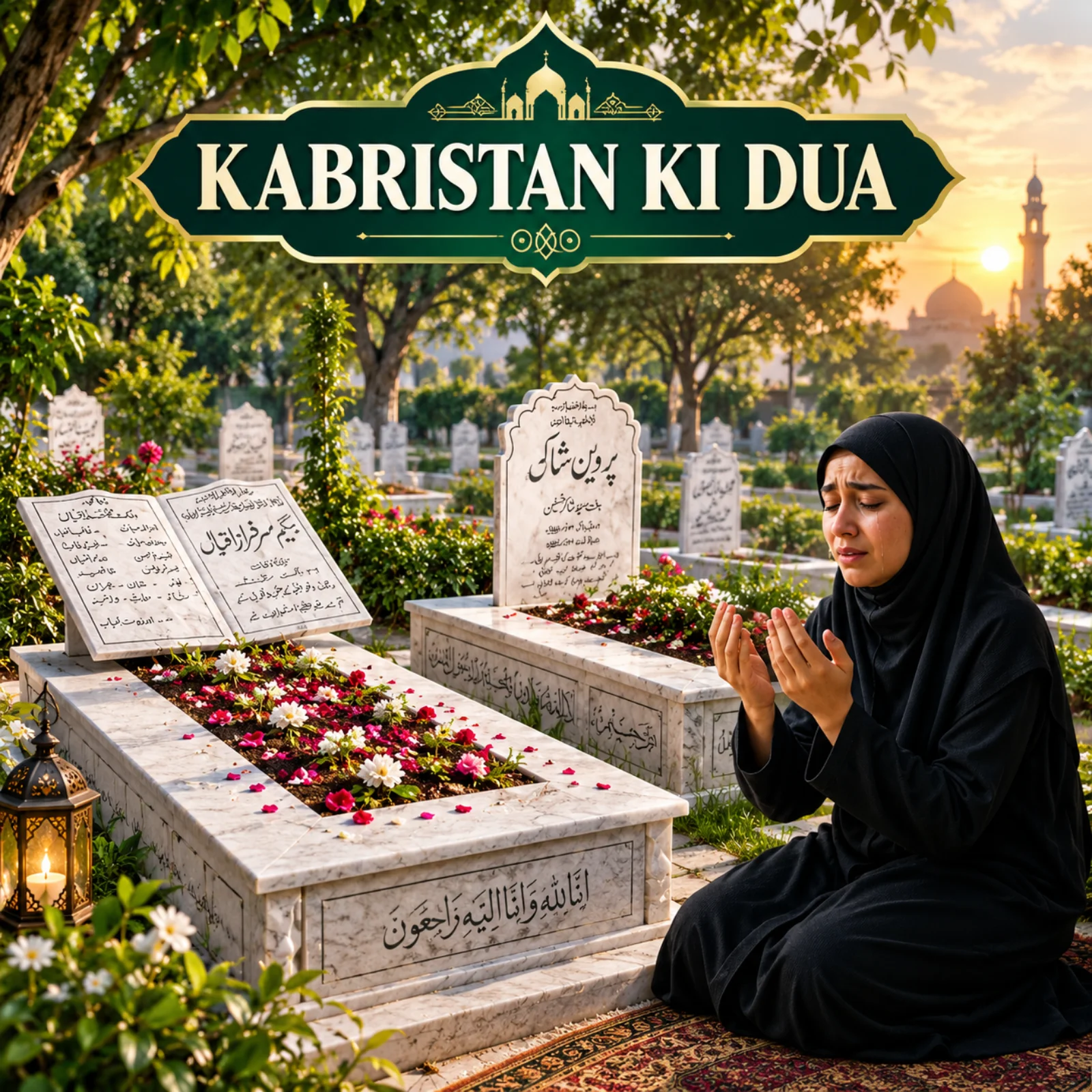
When a Muslim visits a graveyard, Islam has taught specific words to say at that moment. These words are known as Kabristan Ki Dua. The graveyard is a powerful reminder of death and the life after it. Every Muslim is encouraged to visit graves, because it softens the heart and reminds a person that this world is temporary.
The Prophet Muhammad (ﷺ) used to visit graveyards himself and taught his companions the proper dua to say upon entering. This practice is called Ziyarat-ul-Quboor, and it is a Sunnah act.
Kabristan Ki Dua is short, meaningful, and authentic. It is found in Sahih Muslim and other reliable hadith collections. Whether you are visiting the grave of a loved one, going to a graveyard on Shab e Barat, or simply passing by, knowing this dua is important.
Kabristan Ki Dua in Arabic
The most authentic and widely accepted dua for entering a graveyard is:
اَلسَّلَامُ عَلَيْكُمْ أَهْلَ الدِّيَارِ مِنَ الْمُؤْمِنِيْنَ وَالْمُسْلِمِيْنَ، وَإِنَّا إِنْ شَاءَ اللهُ بِكُمْ لَاحِقُوْنَ، نَسْأَلُ اللهَ لَنَا وَلَكُمُ الْعَافِيَةَ
Kabristan Ki Dua Transliteration
“As-Salaamu ‘Alaikum Ahlad-Diyaari Minal-Mu’mineena Wal-Muslimeen, Wa Inna In Sha Allaahu Bikum Laahiqoon, Nas’alullaaha Lanaa Wa Lakumul-‘Aafiyah.”
Kabristan Ki Dua in English – Meaning
“Peace be upon you, O people of these dwellings, from among the believers and the Muslims. And indeed, if Allah wills, we will join you. We ask Allah for well-being for us and for you.”
Kabristan Ki Dua in Urdu – Tarjuma
“اے ان گھروں کے مومن اور مسلمان باشندو، تم پر سلامتی ہو۔ اور بے شک اگر اللہ نے چاہا تو ہم بھی تم سے ملنے والے ہیں۔ ہم اپنے لیے اور تمہارے لیے اللہ سے عافیت مانگتے ہیں۔”
Kabristan Ki Dua in Hindi – Arth
“हे इन घरों के मोमिन और मुसलमान निवासियों, तुम पर सलामती हो। और बेशक अगर अल्लाह ने चाहा तो हम भी तुमसे मिलने वाले हैं। हम अपने लिए और तुम्हारे लिए अल्लाह से आफ़ियत (भलाई) मांगते हैं।”
Hadith Reference – Kabristan Ki Dua Ki Daleel
This dua is mentioned in Sahih Muslim (Hadith No. 975) and also reported in Sunan Ibn Majah and Musnad Ahmad. It was narrated by Hazrat Aisha (رضي الله عنها) that whenever the Prophet (ﷺ) went to Baqee’ (the graveyard of Madinah) at night, he used to say this dua.
This confirms that Kabristan Ki Dua is fully authentic and based on Sunnah. There is no doubt about its correctness.
Explanation – Kabristan Ki Dua Kya Hai
Kabristan Ki Dua Kya Hai? It is the specific Sunnah supplication said upon entering a Muslim graveyard. It serves as a greeting to the deceased, an acknowledgment of one’s own mortality, and a prayer for both the living and the dead.
The dua contains three key messages:
- Salaam to the Deceased – You greet the people in the graves as if they are still present in a different form of life. This is the Islamic belief — that the souls of the deceased are alive in the world of Barzakh.
- Acknowledgment of Death – The words “Wa Inna In Sha Allaahu Bikum Laahiqoon” remind the visitor that they too will one day lie in the same earth. This creates humility and a sense of accountability.
- Du’a for Everyone – The final part asks Allah for well-being (Aafiyah) for both the living visitor and the deceased. This act of remembering and praying for the dead is a beautiful aspect of Islamic brotherhood.
Kabristan Ki Dua Tarjuma Ke Sath – Full Overview Table
| Component | Content |
|---|---|
| Arabic Dua | اَلسَّلَامُ عَلَيْكُمْ أَهْلَ الدِّيَارِ… |
| Transliteration | As-Salaamu ‘Alaikum Ahlad-Diyaari… |
| English Meaning | Peace be upon you, O dwellers of these abodes… |
| Urdu Tarjuma | اے ان گھروں کے مومن باشندو، تم پر سلامتی ہو… |
| Hindi Arth | हे इन घरों के मोमिन निवासियों, तुम पर सलामती हो… |
| Source | Sahih Muslim – Hadith No. 975 |
| Status | Sahih (Authentic) |
Disclaimer: The duas and information shared in this article are taken from authentic Islamic sources and reliable hadith collections. This content is for educational and informational purposes only. We have made every effort to ensure accuracy, but readers are encouraged to verify with a qualified Islamic scholar for personal religious guidance. May Allah accept our efforts. Ameen.
When To Read – Kabristan Ki Dua Ka Waqt
The Kabristan Ki Dua is read in the following situations:
1. Upon Entering the Graveyard
Whenever a Muslim enters a graveyard whether to bury someone, visit a relative’s grave, or offer Fatiha this dua is read as you step in. It should be said quietly and with a sincere heart.
2. While Visiting Any Muslim Grave
When you stop at any grave to offer prayers, this dua is said as a form of greeting and remembrance for the deceased soul.
3. During Shab e Barat
Many Muslims visit graveyards on the night of Shab e Barat (15th of Sha’ban) to pray for their deceased loved ones. Reading Shab e Barat me Kabristan Ki Dua on this night is considered a meaningful act. Although some scholars differ on Shab e Barat practices, visiting graves and making dua for the deceased is always permissible and encouraged in Islam based on authentic hadith.
4. On Eid Days
It is reported that the Prophet (ﷺ) visited the graveyard of Baqi’ on Eid days. Reading this dua on those visits is a reaffirmed Sunnah.
5. When Passing by a Graveyard
Even if you are passing by a graveyard without entering it, it is a good act to say the graveyard dua and remember the people buried there.
Sabe A Barat Me Kabristan Ki Dua – Special Note
Shab e Barat me Kabristan Ki Dua refers specifically to the dua recited when visiting graves on the fifteenth night of Sha’ban. The same authentic dua mentioned above is read. There is no separate or special dua for Shab e Barat the Sunnah dua applies to all graveyard visits at any time.
What makes the visit meaningful on Shab e Barat is the sincere intention to pray for the forgiveness and peace of the deceased. After reciting the entry dua, a Muslim can also:
- Recite Surah Al-Fatiha
- Recite Surah Al-Ikhlas (three times)
- Recite Ayatul Kursi
- Make personal dua in their own language for the departed souls
All of these actions are permitted and spiritually beneficial.
Benefits of Reading Kabristan Ki Dua
1. Following the Sunnah of the Prophet (ﷺ)
Reading this dua is a direct act of following the Prophet Muhammad (ﷺ), which carries immense reward in Islam. Any act performed in line with the Sunnah is a form of worship.
2. Softening of the Heart
The Prophet (ﷺ) said: “Visit the graves, for indeed it reminds you of death.” (Sahih Muslim). Visiting graves and reading the dua breaks worldly attachments and creates awareness of the Hereafter.
3. Du’a for the Deceased
When you read this dua, you are also asking Allah for the well-being of those buried there. This is a form of Sadaqah Jariyah (ongoing charity) an act that benefits the dead through the prayers of the living.
4. Reminder of Accountability
The graveyard visit combined with the dua is one of the most powerful reminders of Qayamah and the Day of Judgment. It helps a Muslim stay focused on good deeds.
5. Spiritual Connection with the Ummah
Praying for deceased Muslims, many of whom may be unknown to you, is a beautiful expression of Islamic brotherhood that has no boundaries of time.
Additional Dua After Entering – Optional Sunnah Practice
After the main Kabristan Ki Dua, some narrations also mention that the Prophet (ﷺ) would make the following addition when visiting the graves of Baqi’:
اَللّٰهُمَّ اغْفِرْ لِأَهْلِ بَقِيعِ الْغَرْقَدِ
“Allahummaghfir li-ahli Baqee’il-Gharqad”
“O Allah, forgive the people of Baqi’.”
This dua was specific to the graveyard of Baqi’, but scholars have generalized the concept after the main greeting dua, you may make any sincere dua asking Allah’s forgiveness and mercy for the deceased.
What to Avoid When Visiting a Graveyard
Islam has also laid down clear guidelines on what not to do at a graveyard:
- Do not sit on graves
- Do not walk on top of graves unnecessarily
- Do not make the grave a place of celebration or excessive rituals
- Avoid loud recitations that disturb others
- Do not build structures over graves
- Avoid mixing of unrelated men and women at graveyards without proper Islamic observance
These points are based on authentic hadith and are important for maintaining the sanctity of the graveyard.
Read Also: Dua After Wudu
Conclusion
Kabristan Ki Dua is one of the most important short duas a Muslim should know. It is fully authentic, directly taken from the Sunnah of the Prophet Muhammad (ﷺ), and carries deep spiritual meaning. Whether you visit a graveyard on a regular day, on Shab e Barat, or during Eid saying this dua is an act of worship, a Sunnah, and a beautiful gift of prayer for those who can no longer pray for themselves.
The Kabristan Ki Dua in Arabic, with its transliteration and meaning in Hindi, Urdu, and English, is now at your fingertips. Memorize it, teach it to your family, and read it every time you pass by or enter a graveyard.
May Allah grant mercy and forgiveness to all our deceased loved ones, ease the trials of the grave for the believers, and keep us firm on the straight path until our own final day. Ameen.
FAQs – Kabristan Ki Dua Ke Baare Mein Sawaal
Q1. Kabristan Ki Dua Kya Hai?
It is the Sunnah dua said upon entering a Muslim graveyard. It begins with “As-Salaamu ‘Alaikum Ahlad-Diyaari…” and is found in Sahih Muslim (No. 975).
Q2. Kya Qabr Par Fatiha Padh Sakte Hain?
Yes. Reciting Surah Al-Fatiha at a grave is widely accepted and considered a spiritual gift (Hadiyah) for the deceased.
Q3. Kya Aurat Bhi Qabristan Ja Sakti Hai?
Yes, according to the majority of scholars. Women may visit graves for dua and remembrance of death, as long as they avoid wailing or un-Islamic rituals.
Q4. Shab e Barat Mein Kabristan Jaana Kaisa Hai?
It is permissible. The same Kabristan Ki Dua is recited. Making dua for the deceased on this night is a good act.
Q5. Kabristan Ki Dua Kitni Baar Padhni Chahiye?
Once upon entering is sufficient. There is no need to repeat it multiple times.
 Read More Duas Every Day At Islamic Dua Hub